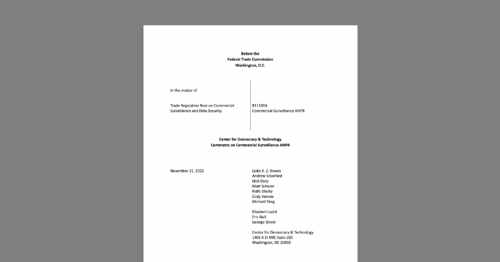
CDT Comments to FTC Regarding Prevalent Commercial Surveillance Practices that Harm Consumers
CDT has long advocated for strong privacy protections for consumers. We commend the Federal Trade Commission (FTC), a critical privacy enforcer at the federal level, for its Advance Notice of Proposed Rulemaking.
The Commission’s action is a promising first step to address the ever-expanding landscape of harmful online data practices. CDT filed comments that focus on common modern online data practices where companies collect, share, and process huge amounts of peoples’ data. Specifically, our comment describes specific private sector practices that have negative effects on marginalized communities and consumers.
The FTC should pass rules that address these gaps. Moreover, CDT’s comment identifies and draws the Commission’s attention to the impacts of harmful data practices used by private contractors for educational institutions and other governmental entities and how an FTC rulemaking should account for and address these harms.
CDT Comment Welcomes NIST Effort to Develop Zero Draft
Drawing on CDT’s previous comments on this NIST effort and our prior research on documentation, our submission welcomes NIST’s effort to develop the zero draft, which provides a much-needed step toward more standardized, high-quality guidance on how developers of AI system components should document key properties and potential sources of AI risk. This guidance will be a valuable resource for organizations to improve interoperability, build more performant AI products, and more effectively identify and mitigate AI risks.
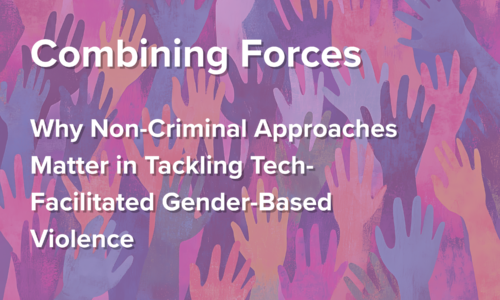
In this brief, CDT Europe delves into the disadvantages that a criminalisation approach may have when it comes to TFGBV and explore the opportunities non-criminal redress mechanisms offers for redress.
Coalition Urges Senate Not to Let Companies Waive Financial Regulations for AI
CDT joined AI Now Institute, American Civil Liberties Union, and several organizations dedicated to tech policy, consumer protection, and civil rights in a letter to Senate leadership and the Senate Banking, Housing, and Urban Affairs Committee opposing the “AI Innovation Labs” language in Sec. 10509 of the CLARITY Act.
As concern about risks and harms related to AI systems continue to grow, a growing chorus of policymakers, industry leaders, and advocates have called for independent AI assessments. This explainer provides an overview of recent proposals for third-party assessment in the United States, including state and federal legislation, executive actions, and industry proposals.