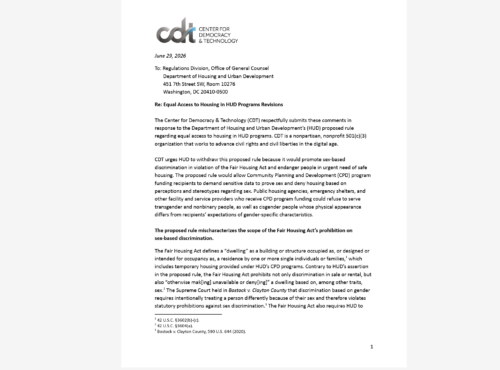
CDT Comment Opposes Proposed Amendments to HUD’s Equal Access Rule
On June 29, CDT filed comments calling on the Department of Housing and Urban Development (HUD) to withdraw proposed amendments to regulations on equal access to housing under HUD’s Community Planning and Development programs. HUD’s current regulations require funding recipients under these programs to have nondiscriminatory policies and procedures ensuring that a person seeking housing is not subjected to intrusive demands for sensitive information to prove their gender identity, and that their eligibility and access is determined without regard to their actual or perceived gender identity.
HUD’s proposed amendments would eliminate these safeguards, instead allowing funding recipients — including public housing agencies, emergency shelters, and other facility and service providers — to violate people’s privacy and discriminate based on sex. Under the current proposal, HUD would defer to funding recipients to demand any “reasonable assurances or evidence” they deem appropriate to establish the sex of a housing applicant or occupant. Funding recipients could implement unreliable and privacy-invasive methods to obtain substantial sensitive information from people in urgent need of safe housing, and funding recipients could use this information to turn people away on a discriminatory basis.
These proposed changes are contrary to the Fair Housing Act’s objectives. HUD should instead focus on fulfilling its responsibility to improve access to the agency’s housing programs.
CDT and Partners Urge Passage of the California Location Privacy Act of 2025 (AB 322)
Location data is particularly sensitive, and when collected across time it can reveal a broad range of intrusive insights such as medical conditions, sexual orientation, political activities, and religious beliefs.
CDT and Allies Urge FCC Not to Violate Privacy of Cell Phone Buyers
CDT and EPIC led a coalition of 15 organizations in urging the FCC not to require phone companies to collect government IDs, physical addresses, and alternate phone numbers from every phone subscriber in the country.
As Brussels starts emptying for the summer, the risks of frontier AI models continue to capture the attention of policymakers as a key chapter of the AI Act becomes enforceable, and disclosure rules around the use of AI systems and AI-generated content are further clarified.