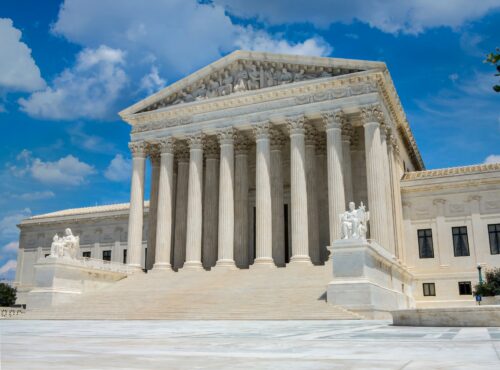
In a victory for the Fourth Amendment this morning, the Supreme Court found that a warrant is required when a suspect has a legitimate privacy interest in records held by a third party.
In Carpenter v. US, the government obtained four months of cell-site location information (“CSLI”) while investigating a series of robberies. Instead of obtaining a warrant supported by probable cause to obtain the CSLI, the government obtained the data pursuant to the Stored Communications Act, which requires a lower burden of proof. The records showed that a Timothy Carpenter’s cell phone was in the vicinity of the location of the robberies. The information was used at trial, where Carpenter was convicted and sentenced to 16 years in prison.
For decades, the courts have summarily ruled “records” as falling outside of the warrant requirement, reasoning that individuals have given up all expectation of privacy by sharing their information with third parties like phone companies, banks, email providers and other everyday services. CDT argued in an amicus brief in Carpenter that it was time for the Supreme Court to evaluate new technologies and data on their merits and determine whether they invoke 4th Amendment interests based on the sensitivity of the information and how it was originally collected.
The majority of the Court agreed with CDT’s position. While the opinion is narrowly tailored to only requiring a warrant for historic CSLI, the Court used sweeping language to describe why individuals have a reasonable expectation of privacy in the whole of their physical movements. The opinion broadly recognizes the way society lives today and notes that the CSLI data sought in this case was far reaching because many individuals “compulsively carry cell phones with them all the time. A cell phone faithfully follows its owner beyond public thoroughfares and into private residences, doctor’s offices, political headquarters, and other potentially revealing locales.” The Court further noted that most cellular providers store up to five years of CSLI, which would allow the government to achieve near perfect surveillance by traveling back in time to retrace a person’s whereabouts.
Importantly, the Court noted that the type of information sought in this case goes far beyond the “business records” that existed at the dawn of the third-party doctrine. The data we generate in our digital lives vastly exceeds the type of information generated only decades ago. By recognizing that individuals retain an expectation of privacy in personal information held by third parties, the Court provided a strong signal that Americans will not lose that constitutional protection as we continue to migrate more of our lives online.
Carpenter is an important win for the Fourth Amendment in the digital age.
Coalition Urges Senate Not to Let Companies Waive Financial Regulations for AI
CDT joined AI Now Institute, American Civil Liberties Union, and several organizations dedicated to tech policy, consumer protection, and civil rights in a letter to Senate leadership and the Senate Banking, Housing, and Urban Affairs Committee opposing the “AI Innovation Labs” language in Sec. 10509 of the CLARITY Act.
CDT-led Coalition Calls for Transparency for White House AI Framework
CDT and Americans for Responsible Innovation led a broad, bipartisan coalition of over two dozen civil society groups in calling on the White House to release its Framework for review of frontier AI models.
CDT Amicus Brief Calls on Fourth Circuit to Rein In Geofence Warrants
Earlier this year the Supreme Court ruled in Chatrie v United States that the Fourth Amendment protected all cell phone location information, which CDT lauded as a landmark decision, but sent the case back down to the Fourth Circuit to assess the propriety of the geofence warrant at issue.
CDT and Partners Post Floor Alert Opposing CA SB 1013 Automated License Plate Readers Bill
The best way to ensure that Automated License Plate Readers are not abused is to limit the retention of stored data and to keep loopholes to lawful process closed. CA SB 1013 is a step in the wrong direction, and we urge the California legislature to reject this approach.