Bossware: CDT and GFI Lead Broad Coalition Warning White House of Risks of Workplace Electronic Surveillance and Automated Management
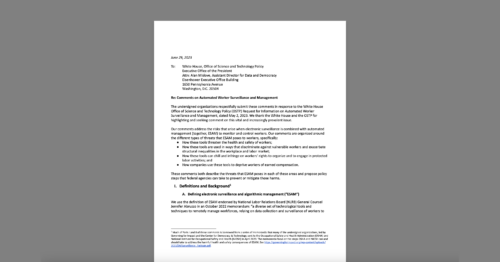
The Center for Democracy & Technology (CDT) and Governing for Impact (GFI) have joined a coalition of 14 organizations to submit detailed comments to the White House Office of Science and Technology Policy (OSTP) in response to its Request for Information (RFI) on the important issue of electronic surveillance and automated management in the workplace.
The comments present a comprehensive analysis of the risks associated with workplace surveillance and automated management tools and emphasize the need for responsible and transparent policies to protect workers’ health, safety, privacy, and dignity.
“As electronic surveillance systems continue to increase in both sophistication and prevalence, it is critical that policymakers take steps to ensure that their use in the workplace does not harm workers,” said CDT President & CEO Alexandra Givens. “CDT is grateful for the Biden Administration’s focus on this issue, which will only rise in importance in the coming years. These comments lay out the risks that surveillance and automated management systems can present to workers and share concrete steps that the Administration can take to protect workers’ safety and workers’ rights.”
Rachael Klarman, Executive Director of Governing for Impact, said, “Workplace surveillance can threaten workers’ rights.”
“The Biden administration has the authority to better regulate this technology, and we hope our comment helps spur immediate action to protect American workers,” she said.
The comments are organized around the different types of threats that surveillance and automated management systems can pose to workers, specifically:
How these tools threaten the health and safety of workers;
How these tools are used in ways that discriminate against vulnerable workers and exacerbate structural inequalities in the workplace and labor market;
How these tools can chill and infringe on workers’ rights to organize and engage in protected labor activities; and
How companies use these tools to deprive workers of earned compensation.
The comments include specific recommendations for how federal agencies–including the Department of Labor, Equal Employment Opportunity Commission (EEOC), Federal Trade Commission (FTC), National Institute for Occupational Safety and Health (NIOSH), and Occupational Safety and Health Administration (OSHA)–can use regulation and public education to prevent and mitigate these risks. The signing organizations hope the OSTP’s request for information is the first step toward concerted interagency action to confront this rising threat to US workers. Some of these recommendations draw from memoranda that CDT, GFI, and many of the other signatories to these comments sent to OSHA and NIOSH earlier this year.
The following organizations have endorsed the comments:
Center for Democracy & Technology Governing for Impact Accountable Tech American Civil Liberties Union Communication Workers of America Jobs With Justice The Leadership Conference on Civil and Human Rights National Employment Law Project National Women’s Law Center Open MIC Service Employees International Union TechEquity Collaborative United Auto Workers Upturn
CDT and Partners Urge Passage of the California Location Privacy Act of 2025 (AB 322)
Location data is particularly sensitive, and when collected across time it can reveal a broad range of intrusive insights such as medical conditions, sexual orientation, political activities, and religious beliefs.
CDT and Allies Urge FCC Not to Violate Privacy of Cell Phone Buyers
CDT and EPIC led a coalition of 15 organizations in urging the FCC not to require phone companies to collect government IDs, physical addresses, and alternate phone numbers from every phone subscriber in the country.
As Brussels starts emptying for the summer, the risks of frontier AI models continue to capture the attention of policymakers as a key chapter of the AI Act becomes enforceable, and disclosure rules around the use of AI systems and AI-generated content are further clarified.