Homeland Security Cybersecurity Bill a Missed Opportunity
Greg Nojeim, CDT Senior Counsel and Director of the Freedom, Security and Technology Project, guest wrote for Lawfare, a site published by the Lawfare Institute in cooperation with the Brookings Institute. It’s solely dedicated to “that nebulous zone in which actions taken or contemplated to protect the nation interact with the nation’s laws and legal institutions.” We’ve published an abridged version here – click below for the full text.
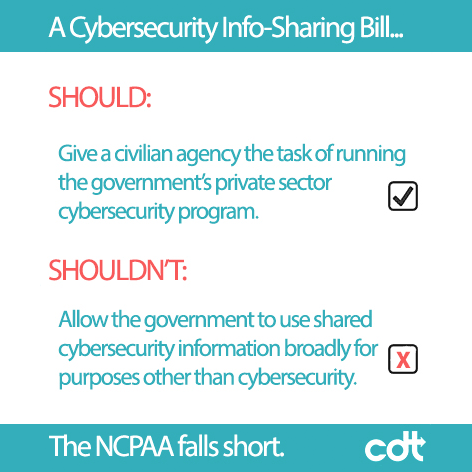
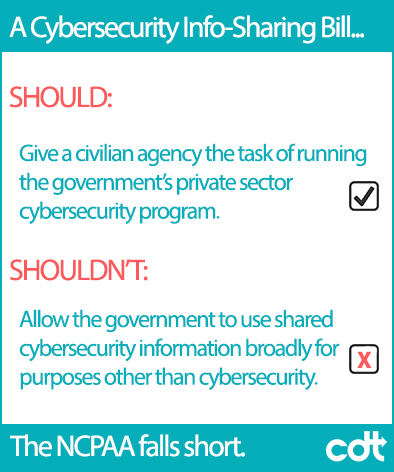
Today, the House Homeland Security Committee marked up a cybersecurity information sharing bill that promised to be “the best of bunch” in terms of civil liberties protections among the cybersecurity information sharing bills that Congress is currently considering. Unfortunately, the bill misses the mark in a key respect: it authorizes monitoring and information sharing for the “cybersecurity purpose” of investigating crimes that have nothing to do with cybersecurity.
CDT-led Coalition Calls for Transparency for White House AI Framework
CDT and Americans for Responsible Innovation led a broad, bipartisan coalition of over two dozen civil society groups in calling on the White House to release its Framework for review of frontier AI models.
CDT Amicus Brief Calls on Fourth Circuit to Rein In Geofence Warrants
Earlier this year the Supreme Court ruled in Chatrie v United States that the Fourth Amendment protected all cell phone location information, which CDT lauded as a landmark decision, but sent the case back down to the Fourth Circuit to assess the propriety of the geofence warrant at issue.
CDT and Partners Post Floor Alert Opposing CA SB 1013 Automated License Plate Readers Bill
The best way to ensure that Automated License Plate Readers are not abused is to limit the retention of stored data and to keep loopholes to lawful process closed. CA SB 1013 is a step in the wrong direction, and we urge the California legislature to reject this approach.
British Public Oppose Secret Surveillance Powers and Want Strong Protections for Encrypted Communications
CDT released nationally representative polling data revealing that a the British public are broadly concerned about the security, privacy, and free speech consequences of allowing law enforcement to access encrypted communications.


 Greg Nojeim, CDT Senior Counsel and Director of the Freedom, Security and Technology Project, guest wrote for