All Sides Agree: After 25 Years, It’s Time to Update ECPA
CDT today hosted a press conference with Senators Ron Wyden (D-Ore.) and Mark Kirk (R-Ill.) highlighting the need to update the Electronic Communications Privacy Act (ECPA), which marks its 25th anniversary this week.
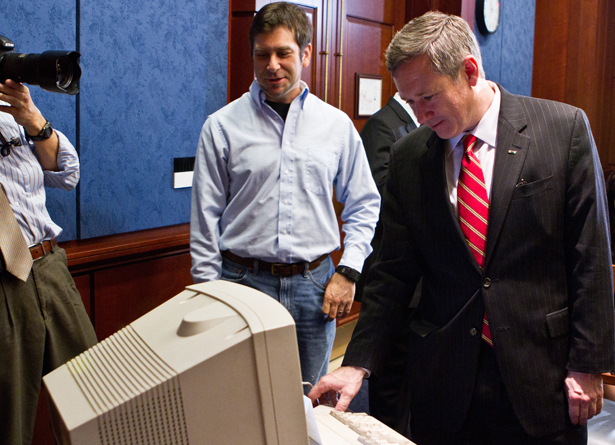
Sen. Mark Kirk with a computer from the mid-1980s.
ECPA is the primary federal statute that specifies standards for government monitoring of cell phone conversations and Internet communications. Despite the fact that technology has developed at a breakneck pace over the last 25 years, ECPA hasn’t been updated since 1986, which has left people’s sensitive personal information—like stored emails and location data from cell phones—vulnerable to being accessed by the government without a warrant.
A Left/Right coalition of groups—including ACLU, Americans for Tax Reform, Competitive Enterprise Institute, Electronic Frontier Foundation, TechFreedom, and the Constitution Project—were on hand as co-sponsors of the press conference.
“Most Americans would be astonished to learn that government agents can track them, 24/7, without getting a warrant from a judge,” said CDT Vice President for Public Policy Jim Dempsey, who moderated the event.
Senators Wyden and Kirk used the opportunity to announce Kirk’s co-sponsorship of the Geolocation Privacy and Surveillance (GPS) Act, which was introduced by Senator Wyden and Rep. Jason Chaffetz (R-Utah). The GPS Act implements one of the four recommendations put forth by the Digital Due Process coalition, a diverse set of organizations and companies calling for ECPA reform:
A governmental entity may access, or may require a covered entity to provide, prospectively or retrospectively, location information regarding a mobile communications device only with a warrant issued based on a showing of probable cause.
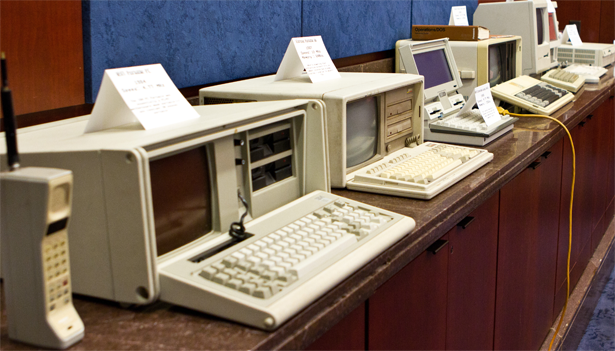
1986-era computers featured in the Retro Tech Fair.
The press conference also featured a Retro Tech Fair, which showcased how far we’ve come in the last 25 years, technologically speaking. For example, most of the computers on display from the 1986-era had between 256 kilobytes and 512 kilobytes of RAM. A computer today will come with about four gigabytes of RAM – 16,000 times more than a common 1986 computer.
“Twenty-five years can seem like several lifetimes when it comes to advancements in technology,” Wyden said. “The rules that governed technology in 1986 don’t always make sense in 2011.”
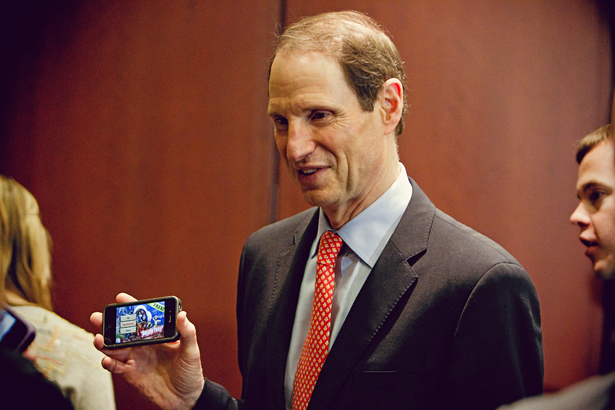
Sen. Ron Wyden displays Oregon Trail on his phone.
“The technological advancements we’ve seen in the past 25 years have revolutionized the way we live our lives, but unfortunately surveillance protections have not kept pace,” Kirk said. “It’s time our digital privacy laws go ‘Back to the Future’ for a sorely needed update.”
You can watch the press conference here. You can also sign the Not Without A Warrant petition asking Congress to update ECPA here.
CDT-led Coalition Calls for Transparency for White House AI Framework
CDT and Americans for Responsible Innovation led a broad, bipartisan coalition of over two dozen civil society groups in calling on the White House to release its Framework for review of frontier AI models.
CDT Amicus Brief Calls on Fourth Circuit to Rein In Geofence Warrants
Earlier this year the Supreme Court ruled in Chatrie v United States that the Fourth Amendment protected all cell phone location information, which CDT lauded as a landmark decision, but sent the case back down to the Fourth Circuit to assess the propriety of the geofence warrant at issue.
CDT and Partners Post Floor Alert Opposing CA SB 1013 Automated License Plate Readers Bill
The best way to ensure that Automated License Plate Readers are not abused is to limit the retention of stored data and to keep loopholes to lawful process closed. CA SB 1013 is a step in the wrong direction, and we urge the California legislature to reject this approach.
British Public Oppose Secret Surveillance Powers and Want Strong Protections for Encrypted Communications
CDT released nationally representative polling data revealing that a the British public are broadly concerned about the security, privacy, and free speech consequences of allowing law enforcement to access encrypted communications.