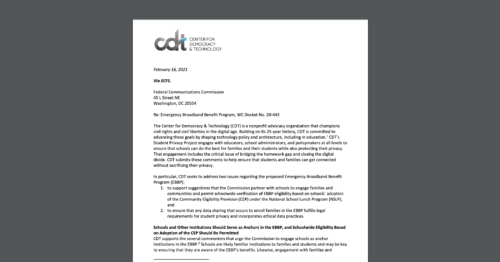
CDT Submits Reply Comment to FCC on Student Privacy in Emergency Broadband Benefit Program
CDT’s Equity in Civic Technology Project submitted this reply comment to the Federal Communications Commission as part of its ongoing work with educators, school administrators, and policymakers at all levels to ensure that schools can do the best for families and their students while also protecting their privacy. That engagement includes the critical issue of bridging the homework gap and closing the digital divide. The reply comment helps ensure that students and families can get connected without sacrificing their privacy.
In particular, CDT sought to address two issues regarding the proposed Emergency Broadband Benefit Program (EBBP):
to support suggestions that the Commission partner with schools to engage families and communities and permit schoolwide verification of EBBP eligibility based on schools’ adoption of the Community Eligibility Provision (CEP) under the National School Lunch Program (NSLP); and
to ensure that any data sharing that occurs to enroll families in the EBBP fulfills legal requirements for student privacy and incorporates ethical data practices.
Coalition Urges Senate Not to Let Companies Waive Financial Regulations for AI
CDT joined AI Now Institute, American Civil Liberties Union, and several organizations dedicated to tech policy, consumer protection, and civil rights in a letter to Senate leadership and the Senate Banking, Housing, and Urban Affairs Committee opposing the “AI Innovation Labs” language in Sec. 10509 of the CLARITY Act.
The Privacy Paradox: How Government Data Has Become Less Private and Less Useful
Providing ready access to information collected and maintained by the government promotes accountability, innovation, and research, making transparency a core responsibility of serving as a steward of the public’s data. Public agencies must also safeguard sensitive information when making data publicly available.
Defending State Data: Lessons from California v. USDA
As the federal government increasingly seeks access to state administrative data, policymakers should consider not only legal authority and privacy implications, but also the practical effects on public confidence, program effectiveness, and states’ ability to fulfill their obligations to residents.
CDT and Partners Urge Passage of the California Location Privacy Act of 2025 (AB 322)
Location data is particularly sensitive, and when collected across time it can reveal a broad range of intrusive insights such as medical conditions, sexual orientation, political activities, and religious beliefs.