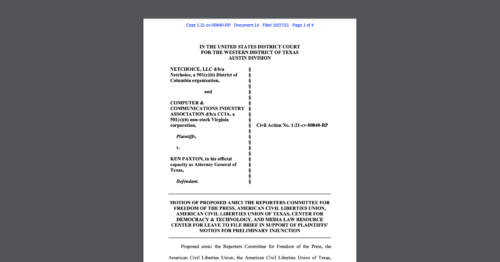
The Center for Democracy & Technology joined an amicus brief by the Reporters Committee for Freedom of the Press in NetChoice v. Paxton. The amicus brief argues that the Texas social media law HB 20, which prohibits certain social media platforms from moderating a user’s content based on “the viewpoint of the user or another person,” violates the First Amendment. Specifically, government efforts to enforce “viewpoint” neutrality infringes on social media companies’ First Amendment right to exercise their editorial judgment in deciding what content they do or do not want to host.
The amicus brief also argues that market concentration alone does not justify prohibiting social media companies from engaging in particular content moderation and that, by regulating only social media platforms with more than 50 million active users in the US in an effort to target certain social media companies because of their editorial choices, HB 20 is subject to strict scrutiny and should be struck down.
HB 20 harms social media users and the public by preventing or chilling platforms from moderating hate speech, disinformation, and violent threats, out of concern that they will run afoul of the law’s prohibition on “viewpoint” discrimination. Users should have the choice of participating in social media platforms that moderate content. Content moderation can help prevent users who are most likely to be targeted by hate and abuse — including women, people of color, LGBTQ people, and other underrepresented groups — from being threatened, abused, and thereby silenced online.
Finally, because it empowers Texas to impose its view of “neutrality” on social media platforms, HB 20 raises the risk that government officials will selectively enforce the law to skew public discourse in their favor. Texas has already opened chilling investigations into the content moderation practices of platforms with which it disagrees. HB 20 creates another way the state can target disfavored social media platforms.
Not All Guardrails Are Created Equal: Comparing Content Safety and Copyright Filtering
As courts and policymakers work through questions about chatbot liability, they should be wary of analogies that flatten meaningful technical differences. Copyright filtering and safety intervention share real challenges around ambiguity and evasion, but they diverge in what each control must assess, how each manifests over the course of a conversation, and how much can be verified from the outside.
Op-Ed: France’s Constitutional Council Ruling Tests the Limits of Social Media Bans
Read our analysis the legal and policy significance of the Constitutional Council’s decision on ongoing social media age restriction and age assurance debates ahead of the most-anticipated EU-wide approach on child online safety due by December 2026.
The brief explains that Section 230’s liability protections are essential to enable free expression online and they extend to the use of automated systems to engage to rank and order content as part of traditional publishing activities.