CDT Leads Brief in Support of Rehearing in Twitter v. Paxton
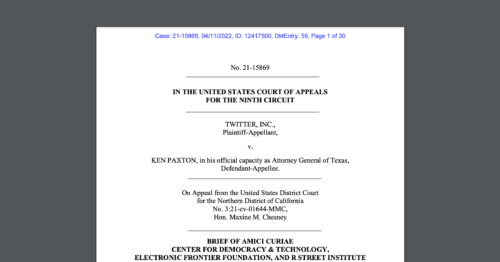
CDT filed an amicus brief in support of Twitter’s petition for rehearing in Twitter v. Paxton. At issue in this case is whether Twitter proceed with its lawsuit challenging a civil investigatory demand (CID) issued by Texas Attorney General Ken Paxton to Twitter in retaliation for Twitter’s decision to permanently suspend President Trump after the attack on the Capitol on January 6, 2021. Although Paxton is purportedly investigating whether Twitter’s representations and practices about what can be posted on its service violate the Texas Deceptive Trade Practices-Consumer Protection, his public statements make clear his true motivation: retaliating against Twitter for exercising its First Amendment right to engage in content moderation.
As CDT explained when we filed our previous amicus brief in this case, Paxton’s investigation harms both internet users and the First Amendment rights of hosts of user-generated content, because a state AG’s investigation and CID targeting a host in retaliation for its content moderation practices will pressure the host into self-censoring, even before the CID is enforced. Unfortunately, a panel of the Ninth Circuit barred Twitter’s lawsuit on procedural grounds, holding that it was not prudentially ripe, or, in other words, not yet ready for judicial decision.
Twitter filed a petition to ask the Ninth Circuit to rehear the case, and CDT’s latest amicus brief supports that request. CDT’s brief, filed on behalf of itself, the Electronic Frontier Foundation, and R Street Institute, argues that the Court should rehear the case because it presents a question of exceptional importance to internet users and the public: whether an online host of user-generated content may challenge a publicly-announced government investigation and CID issued in retaliation for its content moderation decisions, before the investigation is concluded or the CID is enforced.
The amicus brief argues that the panel’s decision, if permitted to stand, will harm users and the public by empowering government officials to use investigations to chill content moderation and even encourage the trend of government officials using investigatory powers to retaliate against and censor content moderation decisions with which they disagree.
Not All Guardrails Are Created Equal: Comparing Content Safety and Copyright Filtering
As courts and policymakers work through questions about chatbot liability, they should be wary of analogies that flatten meaningful technical differences. Copyright filtering and safety intervention share real challenges around ambiguity and evasion, but they diverge in what each control must assess, how each manifests over the course of a conversation, and how much can be verified from the outside.
Op-Ed: France’s Constitutional Council Ruling Tests the Limits of Social Media Bans
Read our analysis the legal and policy significance of the Constitutional Council’s decision on ongoing social media age restriction and age assurance debates ahead of the most-anticipated EU-wide approach on child online safety due by December 2026.
The brief explains that Section 230’s liability protections are essential to enable free expression online and they extend to the use of automated systems to engage to rank and order content as part of traditional publishing activities.