CDT Comments Supporting EEOC’s Recognition of Discriminatory Tech as an Enforcement Priority
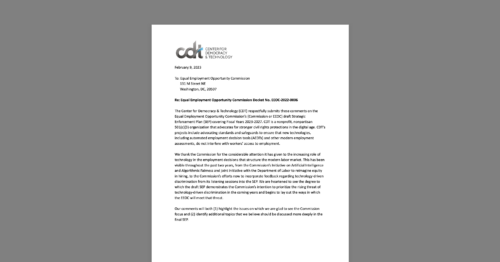
Every few years, the Equal Employment Opportunity Commission (EEOC) presents a multi-year plan describing updates to its subject matter priorities and strategies that will shape its enforcement efforts in the years ahead. The Center for Democracy & Technology (CDT) is encouraged that the EEOC’s Strategic Enforcement Plan for Fiscal Years 2023-2027 (SEP) specifically names discriminatory tech practices among the EEOC’s key focus areas.
CDT submitted comments welcoming the SEP’s explicit recognition of tech’s influence in targeted job advertising, recruitment, and hiring decisions among the EEOC’s top priorities to protect marginalized workers facing numerous barriers to job security. We are also encouraged that the draft SEP affirms the EEOC will build on recent guidance by addressing inaccessible application processes and qualification standards that discriminate against disabled workers.
This attention to tech signals the next phase in the EEOC’s commitment to algorithmic fairness. To ensure the EEOC maximizes the scope of its enforcement authority, CDT recommends that the final SEP also emphasize the need for guidance on how employers should examine the validity of their selection tools. The final SEP should also extend to algorithmic management tools used in the workplace, as certain tech can continue to harm workers even after they get the job.
Finally, the EEOC should offer guidance to employers on how it will apply Title VII of the Civil Rights Act, the Age Discrimination in Employment Act, and other employment discrimination laws to algorithmic bias.
Coalition Urges Senate Not to Let Companies Waive Financial Regulations for AI
CDT joined AI Now Institute, American Civil Liberties Union, and several organizations dedicated to tech policy, consumer protection, and civil rights in a letter to Senate leadership and the Senate Banking, Housing, and Urban Affairs Committee opposing the “AI Innovation Labs” language in Sec. 10509 of the CLARITY Act.
As concern about risks and harms related to AI systems continue to grow, a growing chorus of policymakers, industry leaders, and advocates have called for independent AI assessments. This explainer provides an overview of recent proposals for third-party assessment in the United States, including state and federal legislation, executive actions, and industry proposals.
Having third parties assess AI systems might seem like common sense, but crafting effective policies toward this goal can be devilishly tricky. A poorly-constructed ecosystem for third-party assessment could easily fail to consider the most consequential mechanisms of risk, neglect the AI harms that most impact people, or do more to protect AI companies than people.
Not All Guardrails Are Created Equal: Comparing Content Safety and Copyright Filtering
As courts and policymakers work through questions about chatbot liability, they should be wary of analogies that flatten meaningful technical differences. Copyright filtering and safety intervention share real challenges around ambiguity and evasion, but they diverge in what each control must assess, how each manifests over the course of a conversation, and how much can be verified from the outside.