CDT Testifies Before New York Assembly on AI’s Impact on the Workforce
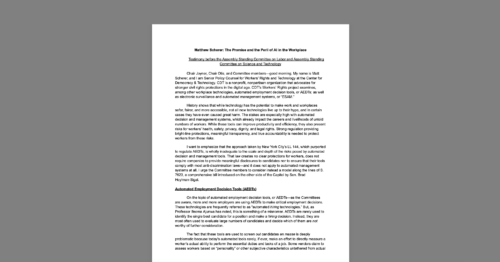
On October 19, 2023, CDT Senior Policy Counsel Matt Scherer testified at a New York Assembly hearing jointly hosted by the Standing Committee on Labor and the Standing Committee on Science and Technology. Matt’s testimony focused on:
The risks that automated employment decision tools (AEDTs) pose to workers, particularly workers with disabilities and other workers from marginalized groups;
The potentially harmful effects of electronic surveillance and automated management (ESAM) systems, especially how ESAM systems can threaten workers’ health and safety; and
The need for legislation providing for robust regulation of both of these technologies.
Not All Guardrails Are Created Equal: Comparing Content Safety and Copyright Filtering
As courts and policymakers work through questions about chatbot liability, they should be wary of analogies that flatten meaningful technical differences. Copyright filtering and safety intervention share real challenges around ambiguity and evasion, but they diverge in what each control must assess, how each manifests over the course of a conversation, and how much can be verified from the outside.
Talking Tech with Roy Austin & Alex Givens on The Future of AI Governance
In this episode of CDT’s Tech Talks, Roy L. Austin, Jr., inaugural director of Howard University School of Law’s AI Initiative, joins Alexandra Givens, President and CEO of the Center for Democracy & Technology, to discuss the challenges and opportunities shaping the future of AI.
CDT-led Coalition Calls for Transparency for White House AI Framework
CDT and Americans for Responsible Innovation led a broad, bipartisan coalition of over two dozen civil society groups in calling on the White House to release its Framework for review of frontier AI models.
CDT and Partners Post Floor Alert Opposing CA SB 1013 Automated License Plate Readers Bill
The best way to ensure that Automated License Plate Readers are not abused is to limit the retention of stored data and to keep loopholes to lawful process closed. CA SB 1013 is a step in the wrong direction, and we urge the California legislature to reject this approach.