CDT Files Amicus Brief in Hachette v. Internet Archive, in Support of Controlled Digital Lending Efforts and Readers’ Privacy
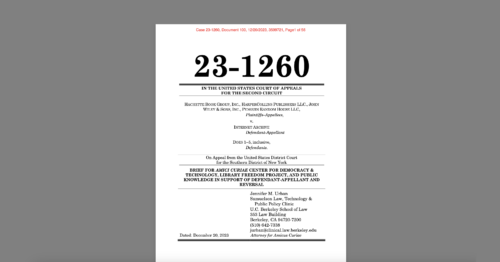
On December 19, CDT, along with Public Knowledge and the Library Freedom Project, filed an amicus brief in Hachette v. Internet Archive in the Second Circuit with the help of the Samuelson Law, Technology, and Public Policy Clinic at University of California at Berkeley. In that case, book publishers are challenging, on copyright grounds, Controlled Digital Lending (CDL) by libraries, which is when libraries create a digital version of their physical books, and then lend those digital copies out to patrons instead of the physical book.
CDT’s brief argues that the court should allow CDL because libraries are much better at protecting reader privacy than are commercial lenders, like Libby. Libraries have a long tradition of ensuring that people’s lending history is protected, whereas commercial lenders often collect significant amounts of data about people including, for instance, titles of books read, passages highlighted, how long it takes a person to read a book, what words the person had to look up, and potentially thousands of other private data points.
Improved reader privacy is crucial for freedom of expression and freedom to access information. If people know they are being watched, they are much less likely to access (potentially controversial) information. That is particularly important in an age where books are being banned in schools, and students may wish to seek those titles at their local library. Without CDL, that information may go straight to publishers and other commercial lenders, and from there to data brokers or other third parties.
Not All Guardrails Are Created Equal: Comparing Content Safety and Copyright Filtering
As courts and policymakers work through questions about chatbot liability, they should be wary of analogies that flatten meaningful technical differences. Copyright filtering and safety intervention share real challenges around ambiguity and evasion, but they diverge in what each control must assess, how each manifests over the course of a conversation, and how much can be verified from the outside.
Op-Ed: France’s Constitutional Council Ruling Tests the Limits of Social Media Bans
Read our analysis the legal and policy significance of the Constitutional Council’s decision on ongoing social media age restriction and age assurance debates ahead of the most-anticipated EU-wide approach on child online safety due by December 2026.
The brief explains that Section 230’s liability protections are essential to enable free expression online and they extend to the use of automated systems to engage to rank and order content as part of traditional publishing activities.