CDT, Alongside 100 Civil Society Organizations, Calls for Human Rights Considerations Amid the UN Ad Hoc Committee’s Cybercrime Treaty Negotiations
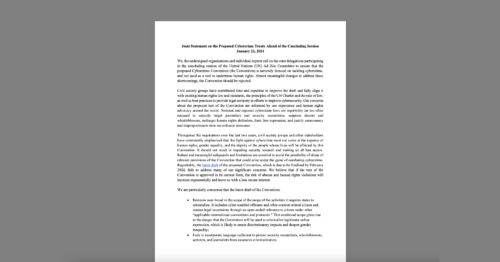
CDT joined over 100 NGOs in signing a Joint Statement on the proposed Cybercrime Treaty ahead of the concluding session of the UN’s Cybercrime Convention. The advocacy statement emphasizes a need for human-centric principles in the fight against cybercrime.
The UN Ad Hoc Committee’s revised draft is expected to be finalized in early February for UN General Assembly ratification. In response, we’ve joined others to advocate that the proposed treaty should only be accepted once meaningful safeguards are added to protect against human rights abuses that arise under the guise of cybercrime prevention.
CDT’s Mallory Knodel recently revisited the 2021 Multistakeholder Manifesto signing ahead of the UN’s Cybercrime Convention which also called for inclusion of safeguards to protect human rights and to maintain an open, free, and trusted internet.
British Public Oppose Secret Surveillance Powers and Want Strong Protections for Encrypted Communications
CDT released nationally representative polling data revealing that a the British public are broadly concerned about the security, privacy, and free speech consequences of allowing law enforcement to access encrypted communications.
Changing Course to Get It Right: The Advisory Committee Reviews Its AI Evidence Rule
CDT is keeping a close eye on Proposed Federal Rule of Evidence 707, which would govern when AI-generated information can be admitted as evidence in federal court — and many state courts where the federal rules are routinely adopted — without a human expert to explain it.