Best Practices for Public Sector AI Use Case Inventories
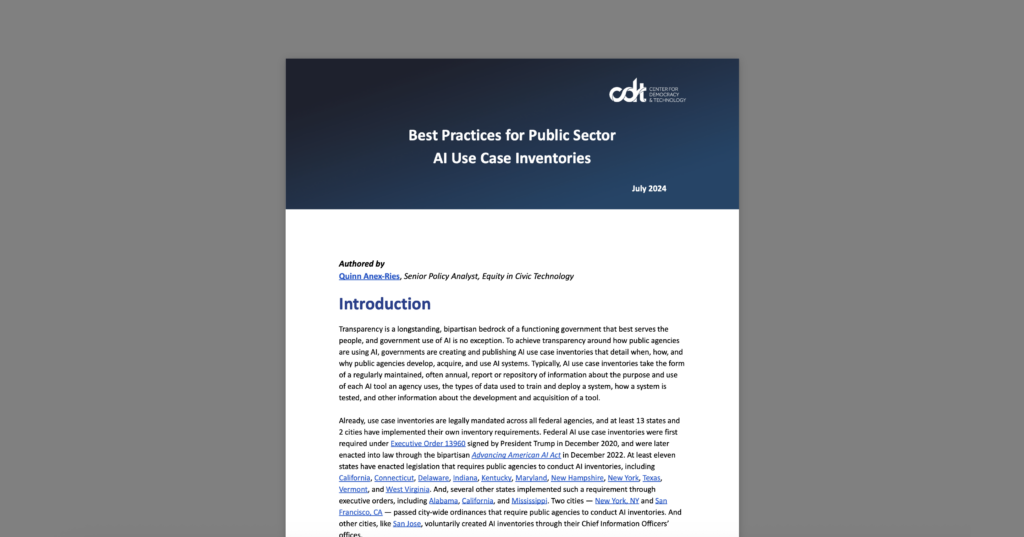
Best Practices for Public Sector AI Use Case Inventories. White document on grey background.
Transparency is a longstanding, bipartisan bedrock of a functioning government that best serves the people, and government use of AI is no exception. To achieve transparency around how public agencies are using AI, governments are creating and publishing AI use case inventories that detail when, how, and why public agencies develop, acquire, and use AI systems. Typically, AI use case inventories take the form of a regularly maintained, often annual, report or repository of information about the purpose and use of each AI tool an agency uses, the types of data used to train and deploy a system, how a system is tested, and other information about the development and acquisition of a tool.
Already, use case inventories are legally mandated across all federal agencies, and at least 13 states and 2 cities have implemented their own inventory requirements. Federal AI use case inventories were first required under Executive Order 13960 signed by President Trump in December 2020, and were later enacted into law through the bipartisan Advancing American AI Act in December 2022. At least eleven states have enacted legislation that requires public agencies to conduct AI inventories, including California, Connecticut, Delaware, Indiana, Kentucky, Maryland, New Hampshire, New York, Texas, Vermont, and West Virginia. And, several other states implemented such a requirement through executive orders, including Alabama, California, and Mississippi. Two cities — New York, NY and San Francisco, CA — passed city-wide ordinances that require public agencies to conduct AI inventories. And other cities, like San Jose, voluntarily created AI inventories through their Chief Information Officers’ offices.
As government AI uses continue to grow, it is all the more urgent for policymakers to proactively communicate to members of the public and other impacted stakeholders (including researchers, academics, private companies, and other branches of government) about the use and impact of AI and to ensure that procedures are in place to enable a robust, ongoing inventory process. Transparency is critical for advancing public trust and the efficient use of public resources, providing insight and accountability into government actions, enabling individuals to make informed decisions and to seek redress if harm occurs, and empowering stakeholders to identify potential gaps or issues in the government’s assessment and oversight of these tools.
Building on past successes and failures in government transparency efforts, this brief outlines best practices in two important facets of AI inventories:
Structure: AI use case inventories should have structural requirements to ensure that they are formatted, shared, and maintained in a manner that is maximally transparent and accessible to stakeholders.
Content: AI use case inventories should include detailed, easily understood information about a system’s purpose, use, and design so that stakeholders have access to meaningful information about how and why constituents are impacted by AI.
The Privacy Paradox: How Government Data Has Become Less Private and Less Useful
Providing ready access to information collected and maintained by the government promotes accountability, innovation, and research, making transparency a core responsibility of serving as a steward of the public’s data. Public agencies must also safeguard sensitive information when making data publicly available.
Defending State Data: Lessons from California v. USDA
As the federal government increasingly seeks access to state administrative data, policymakers should consider not only legal authority and privacy implications, but also the practical effects on public confidence, program effectiveness, and states’ ability to fulfill their obligations to residents.
CDT, EFF, EPIC, and Upturn Submit Comments on GSA’s Updated Draft AI Terms and Conditions for Federal Contracts
Today, the Center for Democracy & Technology and allies submitted comments to the General Services Administration (GSA) in response to the request for comment regarding their updated draft AI Terms and Conditions for federal solicitations and contracts.
Bias at Scale: Understanding AI’s Impact on Student Achievement and Opportunity Gaps
Schools have an opportunity and responsibility to ensure that new technologies support, rather than undermine, their longstanding goal of expanding opportunity.