Like a Bouncer at a Bookstore: Texas’ App Store Accountability Act is Unconstitutional
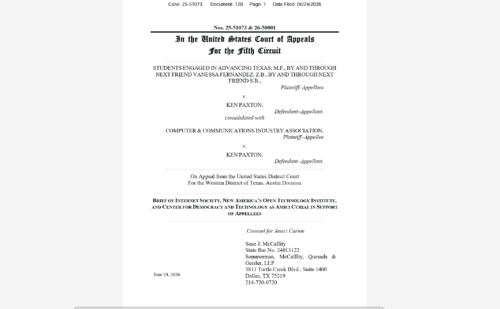
This week, CDT joined the Internet Society (ISOC) and New America’s Open Technology Institute (OTI) to file an amicus brief supporting Students Engaged in Advancing Texas (SEAT) and the Computer & Communication Industry Association (CCIA) in their challenge to Texas’s App Store Accountability Act. The law requires app stores to verify the ages of all of their users and, for minor users, requires parents to approve every app download and re-approve use of apps every time a “significant change” is made — a term broadly defined. App stores must also share age-related data with every app to implement the laws requirements. The district court issued a preliminary injunction preventing the law from going into effect and observing the law was “akin to a law that would require every bookstore to verify the age of every customer at the door.” The Fifth Circuit stayed the injunction pending appeal finding that the law should be subject to a lesser standard of scrutiny that it would be more likely to survive. Now the Fifth Circuit is considering the case in more detail.
Our brief argues that the App Store Accountability Act should not survive either standard of scrutiny applied by the courts. It cites to CDT research showing that parents and their children are exceedingly skeptical of age verification requirements and concerned about the ways they invade privacy. It further argues that parents and children find requirements that parents’ granularly control kids’ online lives to be invasive and overly burdensome. Both of these points underscore the chilling effect the App Store Accountability Act will have on accessing critical speech and other online services for kids and adults alike.
Finally, the brief argues that Texas could have taken a more privacy-protective and less speech-restrictive approach to helping children and their families achieve more appropriate experiences online. For example, Texas could have required the implementation of a voluntary age signaling system, giving parents, teens, and children the ability to choose which apps receive their age data to facilitate appropriate experiences.
Not All Guardrails Are Created Equal: Comparing Content Safety and Copyright Filtering
As courts and policymakers work through questions about chatbot liability, they should be wary of analogies that flatten meaningful technical differences. Copyright filtering and safety intervention share real challenges around ambiguity and evasion, but they diverge in what each control must assess, how each manifests over the course of a conversation, and how much can be verified from the outside.
Op-Ed: France’s Constitutional Council Ruling Tests the Limits of Social Media Bans
Read our analysis the legal and policy significance of the Constitutional Council’s decision on ongoing social media age restriction and age assurance debates ahead of the most-anticipated EU-wide approach on child online safety due by December 2026.
The brief explains that Section 230’s liability protections are essential to enable free expression online and they extend to the use of automated systems to engage to rank and order content as part of traditional publishing activities.