Silenced by Design: Gendered Disinformation and its Threat to Democracy
Introduction
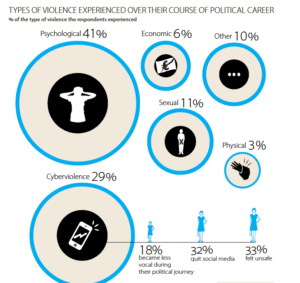
According to recent data, in Europe, 32% of women have experienced violence during their political career, and 29% of those experienced some type of cyberviolence. When focused on the category of women who work in the fields of human rights, activism and/or journalism, a recent UN Women survey reports that 70% of women participants experienced some form of tech-facilitated gender-based violence (TFGBV), and 45% are self-censoring to avoid abuse. These acts are rarely meant as a direct attack against a specific individual, but are more often part of a coordinated effort addressed to the speech of politically engaged women and gender-diverse persons with the goal of silencing them, or even making them quit politics, activism or the online space entirely.
Source: CEMR (2024), Women in Politics: Local and European Trends
Gender-based disinformation – commonly referred to as gendered disinformation – exists at the intersection of gender-based violence and information manipulation, whereby women and LGBTIQ+ people are disproportionately targeted and harassed by the dissemination of false or misleading information about them, especially in the online sphere. It flows from the same patriarchal context in which people experience tech-facilitated gender-based violence, and so there is often an overlap between the two. Indeed, misogynistic remarks that perpetuate gender stereotypes, the non-consensual creation and dissemination of AI-generated content (deepfakes), online harassment that includes illegal hate speech and threats of physical violence are some of the many methods used to spread gendered disinformation.
Women in prominent public-facing roles, such as journalists, activists, and politicians, are disproportionately impacted by gendered disinformation. Several studies and reports, including one by our partner organisation CDT, have shown that women, and women of colour in particular, face numerous online challenges when running for political office, of which gendered disinformation is prominent. While individual women and LGBTIQ+ people are often targets of such acts, growing misogynistic internet movements and coordinated harassment campaigns underscore the fact that the targets are not the individuals in themselves but rather what they represent when in positions of authority. Gendered disinformation is designed to make use of these existing gender narratives, language, and ultimately discrimination to achieve certain social and political goals, including maintaining the status quo of gender inequality or creating a more polarised electorate. Such disinformation campaigns may characterise women and gender-diverse candidates as not being qualified for the position, lacking the requisite knowledge, intelligence, or experience for the role; or as persons who lie, are too emotional for the task, prone to aggression, or lacking sanity. Therefore, by discouraging girls, women, gender-diverse and LGBTIQ+ people from actively participating in politics or civic life, gendered disinformation poses a real threat to inclusive democracy.
For these reasons, CDT Europe has been advocating for a holistic approach to tackling the issue, thus considering the intersection of online disinformation with gender-based violence, and paying particular attention to coordinated campaigns against groups of marginalised people. Building on previous work on the topic, this paper further analyses the problem, with a specific focus on how EU regulations – specifically the Digital Services Act (DSA) and the Directive on Violence Against Women – offer avenues to tackle gendered disinformation, where the normative and enforcement gaps lie, and how this framework should be appropriately implemented to ensure it strikes the right balance in combatting gendered disinformation whilst also preserving freedom of expression.
This paper highlights how, while there are some policy mechanisms and legislative instruments in place, they are severely limited, and have yet to show their potential in tackling the issue. To ensure the legitimacy of the EU’s regulatory strategy in this area, more attention must be paid to elevating the voices that could be silenced by the dissemination of disinformation.
Gendered Disinformation as a Concept
Disinformation is usually associated with misinformation, but it is important to distinguish between the two related, but not identical, concepts. Misinformation refers to false content that is not necessarily shared with harmful intent, while disinformation is intentionally deceptive. According to civil society experts, gendered disinformation refers to manipulative campaigns that exploit gender stereotypes and structural inequalities to target people because of who they are and what they represent in public life. However, since the concept often overlaps with other forms of violence, such as hate speech and online harassment, its definition is quite fragmented, and not entirely clarified by either scholars or legislators.
The concept is generally distinguished from the broader category of tech-facilitated gender-based violence (TFGBV). As previously noted by CDT, “the difference between the two is that gendered disinformation involves intentionally spreading false information about persons or groups based on their gender identity, and online GBV involves targeting and abusing individuals based on their gender identity.” Moreover, when thinking about the issue from a legal standpoint, despite the very concrete harm it provokes, a lot of deceptive information is appropriately not unlawful in and of itself. While broader legal definitions might be able to cover more forms of harm, it can be argued that they may be challenging to operationalise in regulatory systems; on the contrary, narrower categories may allow legal precision and policy targeting, but run the risk of ignoring the common prejudices that cause cumulative harm, and causing excessive and unnecessary censorship of the very same marginalised voices. As previously stated by Saner (2026), the question remains on whether it is possible to distinguish gendered disinformation from common misogyny and gender-based violence in a meaningful way, and whether legislative responses to either can avoid issues with preserving the freedom of expression. In practice, the boundary between all these categories is porous, which is why CDT Europe has been advocating for a nuanced intersectional approach considering the different facets of the issue.
In relation to this intersectional approach, some actors, including the European External Action Service (EEAS), have also been advocating for a broader conceptualisation of identity-based disinformation (IBD), which involves the spread of misleading or false claims related to more than just gender and sexuality, but also race, ethnicity, religion, and other identity markers to silence, undermine, or repress marginalised communities. Identity-based disinformation can be distinguished from other types of online harm, such as harassment, which also use hate and discriminatory language. The introduction of identity into the framework of disinformation helps describe how preexisting preconceptions, stereotypes, and biases can also be weaponised for political ends. Indeed, such disinformation frequently presents violence as a response to perceived threats from a minority group, and exalts it as a virtue. Malicious actors can exaggerate perceived differences and conflicts between groups for political gain and increase the likelihood of conflict and unrest by constructing, maintaining, and taking advantage of societal divisions through such in-group and out-group narratives. By focusing on social groupings, inciting fear, and deepening division, this strategy aims to undermine democratic systems, leaving some parts of society out of them altogether.
Democratic Harms
The democratic harms of gendered disinformation are both immediate and structural. It is well documented that certain features of social media platforms, such as recommender algorithms, have consistently provided users with significant amounts of sensationalised and fraudulent content, which facilitates the organisation, amplification, and inexpensive financing of information attacks against women and gender-diverse people, which can easily reach millions of people and have lasting impacts on their lives and democracies at large.
At the individual level, it creates a chilling effect on speech and participation: women and gender-diverse politically engaged people may try to reduce their visibility, avoid certain topics, step back from campaigning, or leave public-facing roles altogether, as a response to the potential reputational damage, mental distress, and physical safety concerns.
At the systemic level, gendered disinformation, usually combined with political violence, can be a threat to democratic participation, distorting the public sphere by narrowing who is able to speak confidently and persistently in it. When female politicians, journalists, activists, and experts are uniquely burdened by gendered disinformation in conjunction with other forms of TFGBV, and retreat from the public square as a consequence of it, democratic debate becomes less representative and less equal. Masked as accusations of incompetence, illegitimacy and nepotism, these disinformation narratives do not merely negatively impact women and gender-diverse people; they re-code structural misogyny and harmful stereotypes as political commentary, which makes them harder to identify and easier to normalise. The result is a wider loss of narrative pluralism, informed debate, and trust in institutions.
The EU Legal and Policy Framework
At the EU level, measures to address gendered disinformation are captured in concrete legalisation, namely the Digital Services Act (DSA) and Directive on Combating Violence against Women and Domestic Violence, as well as normative measures such as the equality strategies. What emerges is a cross-cutting, and perhaps disparate, picture of a fragmented framework where the ability to strike the balance between mitigating the harm without inadvertently chilling free expression is not entirely clear.
In more detail, the DSA and its system of Codes of Conduct, specifically the one on disinformation, are the most relevant digital governance instruments among the several pieces of legislation connected to this issue. For Very Large Online Platforms and Search Engines (VLOPs and VLOSEs), Art. 34 of the DSA explicitly requires VLOPSEs to assess the way their design features influence systemic risks, and to produce risk assessments covering systemic risks to, among others, fundamental rights, civic discourse, electoral processes, public security and gender-based violence. Art. 35 focuses on the required proportionate mitigation measures. This means that online platforms and search engines are not only reacting to illegal content, but are expected to anticipate and reduce systemic harms, which should evidently include gendered disinformation amplified by algorithms and recommender systems as it is directly related to harms to civic discourse, gender equality and the mental as well as physical health of the people targeted. The Commission also issued specific guidelines for VLOPs and VLOSEs providers on the mitigation of systemic risks linked to electoral processes, which includes specific measures to address gendered disinformation and FIMI targeting the LGBTIQ+ community.
The Directive on Violence Against Women strengthens this framework by focusing specifically on gender-based violence, and criminalising specific forms of cyberviolence, such as incitement to hate and the non-consensual sharing of manipulated personal material. It represents a major step in addressing the issue, as it creates criminal standards for some of the most severe online abuses that often accompany gendered disinformation. In conjunction, these two frameworks should theoretically help mitigate the prevalence of gendered disinformation and assign appropriate measures in cases where significant harm has been caused.
In addition, normative baselines to strengthen measures to push back against gendered disinformation are present in the new Gender Equality Strategy 2026-2030. Here, the European Commission specifically acknowledges the issue of disinformation targeting women politicians and candidates, and supports the idea of making funding available to support women in politics, including for tackling online hate, under the proposed AgoraEU programme. Moreover, the strategy promises enhanced engagement with civil society organisations and community-building initiatives that counter information manipulation and gendered disinformation. As previously announced in the European Democracy Shield proposal, the Commission also committed to presenting a Recommendation on safety in politics for political candidates and elected representatives concerning offline and online threats, including disinformation, and with a specific focus on women. Correspondingly, the Commission has already issued a Recommendation on ensuring the protection, safety and empowerment of journalists, which includes the establishment by Member States of working groups to prevent online attacks against journalists. What is needed now is the translation of this declaration of good intent into practice.
Gaps and Recommendations
In practice, effectively addressing gendered disinformation in the EU will rest upon several key factors including; how member states transpose the standards of the Directive into national law; how well VLOPs/VLOSEs comply with their due diligence obligations under the DSA; and how well cases are contextually assessed by judicial bodies. It will be important therefore, to have institutional guidance provided where necessary and for a greater degree of prioritisation to be placed on gendered harms in the enforcement actions of regulators moving forward.
As a starting point, with the Directive coming into full effect by June 2027, it will be important for the guidance currently being developed by the European Commission for member states on the transposition of the Directive to include detailed guidance on how the criminal standards of the Directive interact with the DSA and how cases should be assessed from a contextual lens as they may intersect with acts of criminality and non-illegal acts that are still harmful, which may be the case with instances of gendered disinformation. In addition, the Commission should issue guidelines on mitigating gender-based violence, including gendered disinformation, under the DSA, in light of the disappearance of the long-committed Code of Conduct on online GBV from the institutional agenda. In combination, this would help align digital and electoral policy aimed at disinformation with gender equality and anti-violence objectives, rather than treating them as separate policy silos.
Other frameworks would also benefit from more specific guidance from the European Commission. For example, despite the Code of Conduct on Disinformation and guidelines on election integrity referencing gendered disinformation, these are facile references at best. Where frameworks attempt to address disinformation from an information integrity lens, recommendations on how a more gender sensitive approach can be adopted would be beneficial.
Moreover, the DSA’s Trusted Flaggers system can, in principle, support faster detection and notification of terms of service violating or potential illegal content, but their effectiveness depends on several factors including the ability for organisation with specific gender expertise to become Trusted Flaggers, or for existing Trusted Flaggers to increase their expertise on gendered harms. In addition, many organisations face operational challenges in becoming trusted flaggers under the DSA due to the potential financial and reporting burdens. Regulators should support pathways for cross-border cooperation and financial empowerment of trusted flaggers who face persistent funding constraints.
The EU should also standardise indicators for gendered disinformation, require more disaggregated data transparency from platforms, and support participatory governance mechanisms that include affected communities and civil society in designing remedies. This is especially important for groups that are routinely undercounted or excluded, because without visible data, invisible harms remain politically easy to ignore. The current framework could be better operationalised to ensure there is sufficient data gathered to develop a deeper understanding on how gendered disinformation campaigns are organised, which tactics are used, who is targeted, and which harms are cumulative. This will be additionally important in combination with the data-access provisions under the DSA. This data gathered at national level through the requirements of the Directive can strongly complement the information vetted researchers should be able to probe as they assess systemic risks. Though, it should be noted that the granting of access for vetted researchers has yet to be successful.
Finally, the EU disinformation response also risks under-protecting trans and non-binary people, whose experiences are frequently absent from monitoring categories and complaint systems. Indeed, while women are increasingly visible in these legislative frameworks, gender identity and expression are not addressed with the same clarity, leaving non-binary and trans people in a more precarious position. They are protected only indirectly through broader equality and anti-harassment principles, rather than through explicit recognition. Moreover, in the absence of gender-disaggregated, profession-disaggregated, and intersectional data, it will remain difficult to measure the real scale of gendered disinformation or assess whether remedies work.
Conclusion
Gendered disinformation hampers the opportunity of women and gender-diverse people wanting to participate in public life. It also subjectively hinders the EU’s own commitments to consistently strive for gender parity in its democratic infrastructure and across all areas of life.
Regulators should first and foremost recognise the unique and urgent nature of the challenges to democracy, representation and gender equality posed by gendered disinformation, addressing any ambiguity and harmonising different pieces of legislation connected to the issue. Specifically, a great step in the right direction would be the issuing of specific guidelines on best practices and recommended measures to treat the issue under Art. 35(3).
Considering the evolving nature of technologies, and the spread of new AI-generated disinformation content, lawmakers will need to adapt to the changing digital landscape, and lay down iterative mechanisms for combating the spread of gendered disinformation, to ensure that the public discourse, both online and offline, continues being more diverse and inclusive, protecting everyone’s freedom of expression and information, and in turn, protecting our democracies.
Op-Ed: France’s Constitutional Council Ruling Tests the Limits of Social Media Bans
Read our analysis the legal and policy significance of the Constitutional Council’s decision on ongoing social media age restriction and age assurance debates ahead of the most-anticipated EU-wide approach on child online safety due by December 2026.
CDT Europe’s Response to the Trusted Flaggers Guidelines Consultation
CDT Europe welcomes the opportunity to respond to the Trusted Flaggers Guidelines public consultation and to reiterate the value of an effectively functioning trusted flagger mechanism in advancing the DSA’s enforcement.
“A Union of Equality” – An Analysis of the European Commission’s New Strategies in the Digital Age
CDT Europe analysed the new EU Equality strategies for 2026 to 2030 in light of their objectives to address gender-based cyber-violence as well as online hatred against racial and ethnically minoritised persons and the LGBTIQ+ community.
Response to the OHCHR’s Call for Inputs on Protection of Human Rights Defenders in the Digital Age
CDT and CDT Europe welcome the opportunity to provide input into OHCHR’s drafting process of the report of the UN High Commissioner for Human Rights pursuant to HRC resolution 58/23 on “Human rights defenders and new and emerging technologies: protecting human rights defenders, including women human rights defenders, in the digital age”.